Pros & cons
What works
- Gas piston system keeps more fouling out of the action
- .300 Blackout performs well out of a short barrel, especially suppressed
- Compact 9-inch barrel excels in tight, close-quarters spaces
- Standard AR-pattern magazine and optics compatibility
Trade-offs
- Federal NFA transfer required: tax stamp and extended wait time
- Not deliverable to California civilians under any circumstances
- Reduced effective range compared to longer-barreled rifles
Specs at a glance
About this product
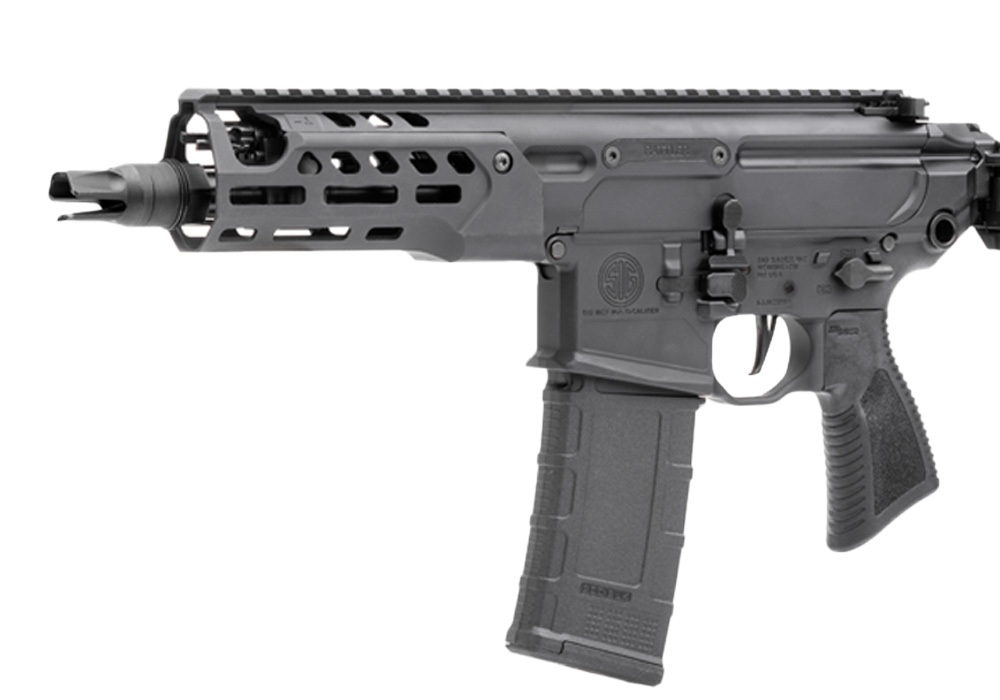
The SIG Sauer MCX Spear LT is a semi-automatic gas-piston rifle built as the civilian-legal version of SIG's next-generation service rifle design, and this listing is chambered in .300 Blackout with a 9-inch barrel, configured as a short-barreled rifle (SBR) under federal NFA rules. That barrel length puts it well under the 16-inch minimum for a standard rifle, which means it's regulated as an NFA item requiring ATF-approved paperwork and a tax stamp before you can take possession, separate from the standard background check process on a normal rifle purchase.
What is the MCX Spear LT?
It's SIG Sauer's semi-automatic, short-stroke gas piston rifle platform, built with an adjustable gas system and designed as the commercial-market sibling to the rifle SIG developed for U.S. military trials. The .300 Blackout chambering is popular specifically on short-barreled builds like this one because the cartridge is designed to perform well out of short barrels, unlike 5.56 NATO which loses more velocity as barrel length drops. The Spear LT line carries over the folding, adjustable stock and free-float handguard design from SIG's larger-caliber Spear rifle, scaled to intermediate cartridges like .300 Blackout.
What is it used for?
Short-barreled .300 Blackout rifles like this one are built for close-quarters use, home defense in tight spaces, and suppressed shooting, since .300 Blackout subsonic loads pair well with a can and a short barrel for a quiet, low-recoil setup. It is not a long-range rifle — the tradeoff for that compact, close-range performance is reduced effective range compared to a longer-barreled 5.56 or full-power rifle cartridge. Vehicle crews, property-defense setups, and suppressor owners building a dedicated quiet-house-gun are the typical buyers for a configuration this short.
How does it compare to a 5.56 carbine of the same length?
At 9 inches, a 5.56 barrel gives up a significant amount of velocity and reliable expansion compared to a 16-inch carbine, which is exactly the gap .300 Blackout was designed to close — the heavier .30-caliber bullet doesn't depend on high velocity the same way 5.56 does to perform. Felt recoil is also generally softer with .300 Blackout subsonic loads than with short-barreled 5.56 loads running at full pressure. The trade is ammunition cost and availability, since 5.56 is cheaper and more widely stocked than .300 Blackout.
What fits it?
It uses standard AR-pattern magazines and accepts common AR-15 optics and accessory mounts on its rail system. Because .300 Blackout shares the same case head dimension as 5.56/.223, many AR-15 magazines work across both calibers, though always confirm magazine compatibility with your specific build. A quality suppressor rated for .300 Blackout is the natural accessory pairing here, given how much of this rifle's design intent centers on a short, suppressed, close-range package.
Who is this not for?
Anyone not prepared for the NFA process — the wait time, the tax stamp, and the paperwork involved in transferring a short-barreled rifle — should look at a standard 16-inch-or-longer configuration instead. It's also not the right tool for long-range shooting, where a longer barrel and a higher-velocity cartridge will outperform this compact setup.
Does it work in California?
No. California law prohibits civilian possession of short-barreled rifles regardless of federal NFA approval — a valid federal tax stamp does not make an SBR legal to possess in this state for civilians. We cannot deliver this configuration to a California resident; if you want an MCX Spear LT for California use, ask us about a compliant, standard-length-barrel configuration instead. Details on state firearm restrictions, including how the assault weapon and magazine-capacity rules apply to standard-length AR-platform rifles we can sell here, are on our California gun laws page.
FFL transfer required
This item is a firearm and ships only to a licensed FFL dealer, never to a home address. At checkout, enter your preferred dealer as the shipping address, or leave it blank and we will assign a licensed dealer near you at no extra cost. You complete the background check and paperwork with the dealer when you pick up.
California buyers: handguns must be on the California roster for delivery to a California FFL, a Firearm Safety Certificate (FSC) and DROS are handled at the dealer, and the 10-day waiting period applies. Out-of-state buyers receive the firearm through their own local FFL under their state's rules.
Key attributes
| Transfer | Ships to your FFL dealer |
| Caliber | .300 Blackout |
| Barrel Length | 9 in (SBR, NFA-regulated) |
| Action | Semi-automatic, short-stroke gas piston |
| Regulatory Status | NFA short-barreled rifle |
Frequently asked questions
- Can I buy this and take it home the same day?
- No. As an NFA short-barreled rifle, it requires ATF approval of the transfer paperwork and tax stamp before you can take possession, which typically takes months, not days.
- Is a tax stamp for this SBR enough to make it legal in California?
- No. California bans civilian possession of short-barreled rifles regardless of federal NFA approval, so a tax stamp does not make it legal to possess in this state.
- Why is .300 Blackout common in short-barreled rifles?
- The cartridge was specifically designed to retain more of its performance out of short barrels and to work well with subsonic ammunition and a suppressor, unlike 5.56 which loses significant velocity as barrel length drops.
- Does the gas piston system need different maintenance than a direct-impingement AR?
- Gas piston systems generally keep more carbon and fouling out of the receiver compared to direct impingement, which can mean less frequent bolt carrier group cleaning, though the piston system itself still needs regular maintenance.